
Dans ce post
Vous vous demandez quels sont les avantages de la traduction ? Si c'est le cas, vous n'êtes pas seul.
Vous surprendrez souvent de nombreux débutants poser des questions telles que :
- Dois-je traduire mon site Web ?
- Quels sont les avantages de la traduction ?
- La traduction de site web est-elle un investissement rentable ?
- Quels sont les avantages de la traduction automatique ?
- Et des questions similaires.
Si vous vous trouvez dans une telle situation, ne vous inquiétez pas le moins du monde.
Dans l'article d'aujourd'hui, nous allons examiner plusieurs avantages de la traduction.
Pourquoi ?
Nous visons à vous aider à décider si la traduction de votre site web vaut votre temps et votre argent.
Ou si vous deviez oublier la traduction de votre site web et vous en tenir à une seule langue.
Mais d'abord, donnons un peu de contexte pour créer l'élan 🙂
Les avantages de la traduction : les statistiques
L'anglais est sans doute l'une des langues les plus parlées au monde, avec plus de 1,4 milliard de locuteurs, selon Statista.
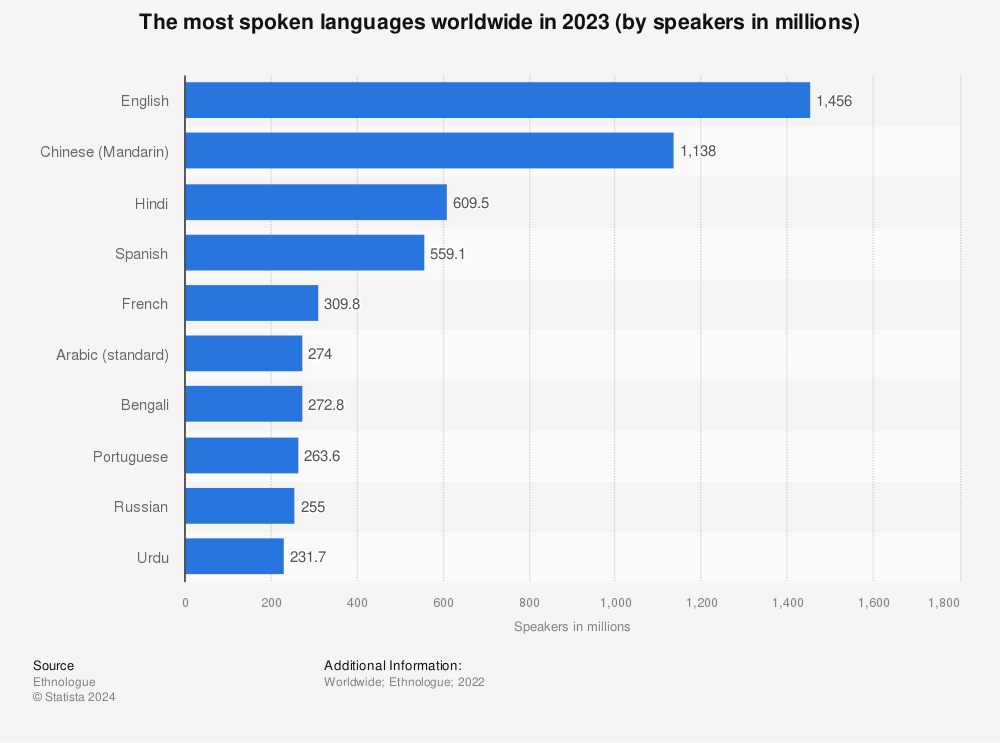
Ce nombre comprend environ 380 millions de locuteurs natifs et 1,077 milliard de personnes qui parlent anglais comme langue seconde.
Dans le même temps, le chinois mandarin est la langue la plus populaire par le nombre de locuteurs natifs.
C'est exact, plus de 939 millions de personnes parlent le mandarin comme langue maternelle.
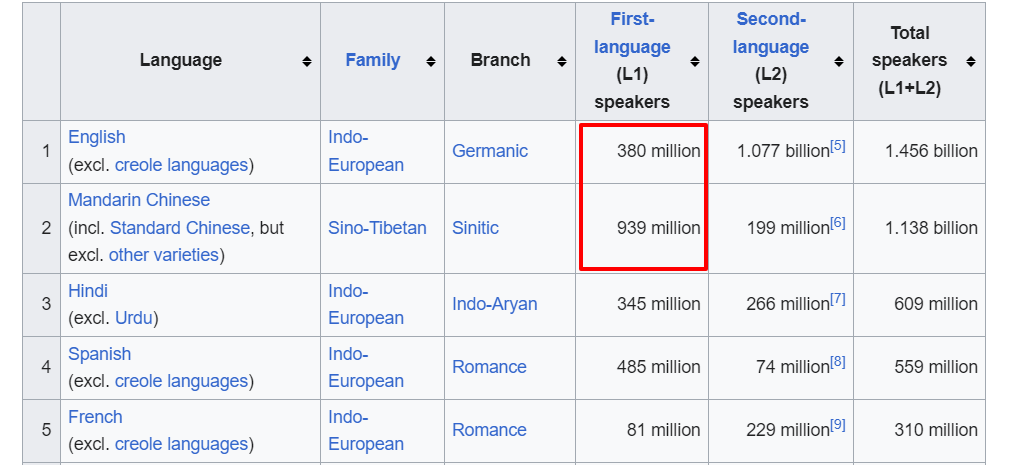
Hindi, espagnol, et Français prenez les troisième, quatrième et cinquième positions, comme indiqué dans le tableau ci-dessus à partir de Wikipédia.
Maintenant, voici la chose.
Si vous avez un site web en anglais, vous avez une audience probable d'environ 1,456 milliard de personnes.
Si vous traduire le site web en chinois, ce public s'agrandit de 1,138 milliard de personnes supplémentaires.
Traduisez votre site Web en anglais dans les cinq langues les plus parlées, et votre public potentiel sautera à plus de 4,072 milliards de personnes.
Bien que vous n'atteigniez pas toutes ces personnes, vous voyez où je veux en venir.
L'un des principaux avantages de la traduction est atteindre un public plus large dans leur langues maternelles.
Et comme le disait malicieusement Nelson Mandela :
Si vous parlez à un homme dans une langue qu'il comprend, cela lui va à la tête. Si vous lui parlez dans sa propre langue, cela lui va au cœur.
Encore une fois, je crois que vous voyez où je veux en venir.
Je veux dire. Vous voulez capturer les nuances culturelles et les subtilités de la langue cible, d'autant plus si vous visez à localiser votre contenu.
Ce ne sont là que deux des avantages de la traduction. Nous en aborderons d'autres plus loin dans l'article.
Après cela, nous partagerons quelques astuces pratiques et l'une des meilleurs outils de traduction au marché.
Avec ce préambule, plongeons directement dans le vif du sujet.
Qu'est-ce que la traduction ?
Pour de nombreux débutants, la traduction semble simple au début. Prenez un texte et traduisez-le dans une autre langue. C'est aussi simple que A, B, C. N'est-ce pas ?
Qu'est-ce que ça pourrait être difficile ? Et qu'est-ce qui pourrait mal se passer ?
Il s'avère que la traduction est un peu plus difficile que vous ne l'aviez imaginé, et beaucoup de choses peuvent mal tourner si vous manquez le coche.
À son niveau le plus élémentaire, la traduction consiste à convertir votre texte dans d'autres langues.
Dans les applications du monde réel, la traduction implique de convertir tout le contenu de votre site web dans d'autres langues.
Quand je dis tout, je veux dire votre :
- Contenu textuel – Cela comprend le texte de votre site web, les e-books, les PDF, les rapports, les infographies, le matériel de marketing, les sous-titres, les transcriptions, les liens, et plus encore ;
- Traduction d'image – Vous pouvez traduire des images de marque telles que les logos, les photos de produits, les produits dérivés et autres supports marketing ;
- Éléments SEO – Pour de meilleurs résultats, il est préférable de traduire vos méta descriptions, slugs d'URL, texte alternatif et autres éléments ;
- Traduction multimédia – Essayez de traduire votre contenu audio ou vidéo dans d'autres langues. Cela implique de traduire des podcasts, cours vidéo, quiz interactifs, livres audio, et bien plus encore ;
- Menus de navigation – Vous devriez traduire vos menus pour une meilleure expérience utilisateur dans la langue cible ;
- eCommerce – Il faudrait considérer traduire votre boutique WooCommerce pour toucher un public plus large, engager les clients et augmenter vos taux de conversion ;
- Argot – Vous souhaitez traduire avec précision des expressions familières et informelles dans votre contenu ;
- Votre tableau de bord d'administration – Permettez aux auteurs, modérateurs et autres utilisateurs de différentes origines linguistiques de choisir les langues qu'ils souhaitent dans le tableau de bord d'administration ;
- Et plus.
Les éléments clés d'une traduction efficace
Comme vous pouvez le constater, la traduction de votre site web va bien au-delà du contenu textuel.
Cela dit, la traduction de sites web est un processus réalisable qui implique les éléments suivants.
- Expertise en linguistique – Pour de meilleurs résultats, il faut une compréhension approfondie des langues impliquées dans la traduction. C'est particulièrement vrai si vous traduisez votre site web vous-même plutôt que d'engager un société de traduction;
- Précision de la traduction – Le contenu que vous traduisez doit conserver le contexte et le sens du message source ;
- Sensibilité culturelle – En tant que traducteur professionnel, vous devriez tenir compte des nuances culturelles et des locuteurs natifs des langues concernées. Sinon, vous pourriez offenser le public cible ;
- Compréhension et vocabulaire – Des traductions précises exigent une bonne maîtrise des termes, des expressions et des tournures utilisés dans le contenu ;
- Les bons outils de traduction – Traduire un site web est un processus ardu qui peut faire sortir le meilleur d'entre nous de leurs gonds. Pour cette raison, vous avez besoin des meilleurs outils de traduction à portée de main. Cela inclut systèmes de gestion de traduction (TMS) et outils d'automatisation.
Ces cinq éléments vous seront utiles, que vous traduisiez du contenu manuellement, à l'aide d'un logiciel ou en faisant appel à un traducteur tiers.
Ressource connexe: Comptes de traducteurs autoriser des traducteurs tiers à traduire le site web directement depuis le front end.
Cela étant dit, passons rapidement en revue les avantages de la traduction.
Quels sont les avantages de la traduction ?

Bien que la traduction d'un site Web puisse être difficile, elle offre plusieurs avantages qui en valent la peine.
Voici quelques avantages de la traduction à garder à l'esprit.
1. Portée et accessibilité améliorées
L'un des principaux avantages de la traduction est l'élargissement de votre public cible.
Traduire le contenu de votre site web en plusieurs langues est un moyen incroyable de surmonter les barrières linguistiques. Cela vous permet d'atteindre un public cible plus large composé de personnes qui ne parlent pas l'anglais comme langue maternelle ou seconde.
De plus, traduire votre site web en plusieurs langues vous permet d'atteindre les utilisateurs qui parlent des langues minoritaires. En faisant cela, vous élargissez votre public potentiel tout en favorisant l'inclusivité et une clientèle fidèle.
Dans le même temps, la traduction de sites Web vous permet de cibler des marchés nouveaux et émergents aux origines linguistiques diverses. Lorsque vous proposez des langues pertinentes pour ces nouveaux marchés, vous pouvez rapidement vous établir dans des régions où votre entreprise est inconnue.
Avec un contenu multilingue, votre entreprise peut attirer l'attention du monde entier grâce au partage sur les réseaux sociaux, au bouche-à-oreille et à la visibilité dans les moteurs de recherche. Cela entraîne une notoriété et une reconnaissance de marque accrues à l'échelle mondiale.
Autrement dit, la traduction de sites web vous permet de rendre votre contenu accessible à des publics diversifiés issus de différents horizons culturels et linguistiques. C'est une approche stratégique qui élargit la portée de votre marque et démontre votre engagement envers l'inclusivité et la sensibilité culturelle dans une économie mondialisée.
Par exemple, CodeLobster ont touché un public international plus large après avoir traduit leur site Web et leur IDE PHP en plusieurs langues. Ils utilisent également un sélecteur de langue menu dans les langues maternelles, permettant aux utilisateurs de choisir facilement leur langue.
2. Amélioration de la réputation de la marque
Pour faire le lien avec le point précédent, l'amélioration de la réputation de votre marque est un autre avantage majeur de la traduction.
Lorsque vous traduisez votre site Web en plusieurs langues, vous pouvez vous adresser efficacement à des publics multilingues et multiculturels.
C'est ce que je veux dire.
Traduire votre contenu vous offre l'opportunité idéale d'apprécier la diversité culturelle des visiteurs de votre site web. C'est une excellente façon de démontrer votre engagement envers l'inclusivité, ce qui renvoie une image positive de votre marque.
Deuxièmement, la traduction de sites web vous permet d'adapter votre contenu aux intérêts et préférences locaux.
Comment cela contribue-t-il à renforcer la réputation de votre marque ?
C'est simple. Lorsque vous démontrez que vous comprenez les coutumes locales, l'argot et les nuances culturelles, votre contenu trouve un écho auprès du public cible.
Cela conduit à un meilleur engagement des utilisateurs, à une acceptation par les natifs et à une réputation de marque améliorée.
Troisièmement, parler à votre public dans sa langue maternelle favorise un sentiment de familiarité et confiance.
Cela renforce la crédibilité et facilite des liens plus solides et plus sains entre les utilisateurs mondiaux et votre marque.
Il y a plus...
Traduire votre site web de manière professionnelle vous permet d'éviter les malentendus culturels et les contenus choquants. Cela vous aide à préserver la réputation et l'intégrité de votre marque sur un marché mondial.
Toujours en ce qui concerne la réputation de la marque, offrir des expériences utilisateur fluides dans différentes langues renforce la fidélité à la marque. Cela encourage les visites répétées sur votre site et des relations à long terme avec votre entreprise.
Si vous jouez bien vos cartes, les clients satisfaits deviennent des ambassadeurs de la marque qui font la promotion de votre entreprise gratuitement.
Je veux dire. Des clients multilingues satisfaits recommandent vos produits ou services à leurs amis et à leur famille. Cela amplifie le bouche-à-oreille et contribue à la promotion de la marque, ce qui améliore la réputation de votre entreprise.
Enfin, la traduction de sites Web vous permet de vous démarquer de vos concurrents qui n'ont pas adopté la communication multilingue.
Si vous vous posez la question, c'est un moyen efficace de vous démarquer et d'attirer des personnes qui adhèrent à votre message global.
Comment cela améliore-t-il la réputation de votre marque ?
Premièrement, cela vous établit comme une organisation avant-gardiste et axée sur le client. Deuxièmement, proposer du contenu multilingue est une pratique courante sur le marché mondial d'aujourd'hui.
Les clients s'attendent à ce que votre marque offre une expérience utilisateur inclusive qui influence positivement la façon dont les gens perçoivent votre entreprise.
3. Expérience utilisateur améliorée
Un autre grand avantage de la traduction est l'amélioration de l'expérience utilisateur sur votre site web.
Pourquoi est-ce important ?
Améliorer l'expérience utilisateur est crucial pour captiver et fidéliser votre public cible.
Tout d'abord, la traduction de votre contenu élimine les barrières linguistiques. Cela permet à des personnes de différents horizons de comprendre et d'utiliser votre site Web, d'où qu'elles viennent.
En vous adressant à des locuteurs de différentes langues, vous démontrez votre engagement envers l'accessibilité et l'ergonomie, ce qui rend votre site web accueillant pour un plus grand nombre de personnes.
De plus, traduire votre site web vous permet d'offrir des expériences personnalisées à vos utilisateurs. Vous pouvez adapter votre contenu à des groupes et des sous-cultures, en répondant à leurs intérêts distincts et à leurs origines culturelles.
Deuxièmement, la traduction vous permet de localiser votre site web. Ainsi, vous pouvez adapter des éléments tels que les images, les devises et les formats de date aux conventions et coutumes locales. Cela améliore l'engagement des utilisateurs et crée un sentiment d'appartenance parmi eux.
De plus, vous pouvez diffuser des messages marketing dans la langue maternelle de l'utilisateur, ce qui entraîne une satisfaction accrue des utilisateurs et davantage de conversions.
Troisièmement, la traduction de votre contenu est un moyen efficace d'augmenter le temps de consultation. En effet, les utilisateurs d'horizons linguistiques différents passent plus de temps à interagir avec du contenu dans une langue qu'ils comprennent.
Cela conduit à son tour à un engagement accru des utilisateurs et à une plus grande immersion sur votre site web.
De plus, offrir une expérience multilingue fluide entraîne de plus faibles taux de rebond.
Pourquoi ?
Les utilisateurs sont plus susceptibles de passer plus de temps sur votre site Web et d'explorer plus de pages lorsqu'ils peuvent facilement comprendre votre contenu.
4. Amélioration du référencement et de la visibilité
Si vous débutez encore dans le marketing numérique, référencement naturel consiste à optimiser votre site web et votre contenu pour obtenir un meilleur classement dans les pages de résultats.
Mais en quoi la traduction de votre site web en plusieurs langues améliore-t-elle le référencement et la visibilité ?
Pour commencer, nous avons l'optimisation des mots-clés multilingues.
Lors de la traduction de votre site web, commencez par effectuer une recherche de mots-clés dans différentes langues. Cela vous permet d'identifier les mots-clés et expressions pertinents que les visiteurs locaux utilisent pour trouver votre contenu.
Ensuite, optimisez votre contenu multilingue avec ces mots-clés pour améliorer votre classement dans les pages de résultats des moteurs de recherche (SERP).
Deuxièmement, la traduction de votre contenu en plusieurs langues vous aide à étendre votre portée géographique.
Cela vous aide à renforcer votre présence sur les marchés internationaux. Par conséquent, davantage de personnes peuvent découvrir votre site Web et interagir avec lui en utilisant des requêtes de recherche localisées.
En outre, vous pouvez utiliser l'optimisation de contenu gé Ciblée pour adapter votre contenu à des contextes culturels et à des régions géographiques spécifiques.
Cela aide les moteurs de recherche à comprendre la pertinence de votre contenu pour les utilisateurs locaux, ce qui se traduit par un meilleur classement pour les recherches spécifiques à un lieu.
Troisièmement, la création de contenu multilingue utile montre aux moteurs de recherche que votre site web fait autorité et est digne de confiance. Cela conduit à une plus grande autorité de domaine et à de meilleurs classements dans les résultats de recherche spécifiques à chaque langue.
De plus, l'obtention de backlinks provenant de sites Web locaux augmentera votre autorité et votre pertinence dans les recherches locales, ce qui entraînera un trafic organique accru et des performances SEO améliorées.
En même temps, l'optimisation des méta-descriptions, des titres et des balises alt dans chaque langue est un moyen infaillible de garantir que votre contenu est représenté avec précision dans les résultats de recherche locaux.
Cela se traduit par des taux de clics plus élevés et une meilleure visibilité dans les SERP.
Mais ce n'est pas tout...
Proposer votre contenu en plusieurs langues réduit vos taux de rebond.
Le taux de rebond est un facteur de classement important pour Google. Il représente le pourcentage de personnes qui quittent votre site Web immédiatement et sans interagir avec d'autres pages.
Pour les moteurs de recherche, un taux de rebond extrêmement élevé indique que les gens ne trouvent pas votre contenu utile ou que quelque chose sur votre site web est cassé.
Par conséquent, les moteurs de recherche vous attribuent des classements inférieurs, et inversement.
Proposer votre contenu en plusieurs langues incite les visiteurs du site web à rester plus longtemps et à explorer davantage de pages puisqu'ils comprennent les informations que vous présentez.
Cela réduit votre taux de rebond, ce qui est définitivement ce que vous voulez.
Autre chose.
Traduire votre site web en tenant compte de la pertinence contextuelle vous permet de capturer un large éventail d'intentions d'utilisateurs.
Cela vous permet d'optimiser votre contenu multilingue pour les mots-clés de longue traîne et les requêtes de recherche spécifiques à une niche.
Vous devez également surveiller les tendances culturelles dans différentes régions. Cela vous permet d'aligner votre contenu sur les recherches locales afin que votre site Web reste pertinent et compétitif en matière de référencement.
Enfin et surtout, le suivi des performances de vos efforts de référencement multilingue fournit des données précieuses sur le classement des mots-clés, l'engagement des utilisateurs et les taux de conversion.
Vous pouvez utiliser ces données pour votre planification stratégique et pour améliorer vos futures campagnes de référencement multilingues.
Pour ne citer qu'un exemple rapide, Neil Patel, spécialiste renommé du marketing en ligne, a augmenté son trafic de 47% et le nombre de nouveaux utilisateurs de 60% après traduire son site web en 82 langues!
5. Augmentation des conversions et du chiffre d'affaires
Un autre avantage passionnant de la traduction est l'augmentation des taux de conversion et du chiffre d'affaires.
Je dis excitant parce que qui n'aime pas gagner plus d'argent ? Après tout, le chiffre d'affaires est le principal objectif et l'élément vital de toute entreprise.
Alors, comment la traduction de votre site web dans un plus grand nombre de langues augmente-t-elle les conversions et le chiffre d'affaires ?
Commençons par les conversions.
Une conversion se produit chaque fois qu'un utilisateur effectue une action souhaitée sur votre site Web.
Cela pourrait être :
- Décrochant le téléphone pour t'appeler ;
- Remplir un formulaire de contact;
- Téléchargement d'un fichier;
- Je m'inscris à votre newsletter par e-mail;
- Cliquer sur des liens d'affiliation;
- Et l'achat d'un produit, entre autres.
Enregistrer des taux de conversion élevés sur votre site Web signifie que vous faites les choses bien.
Un faible taux de conversion est exactement le contraire.
Comment la traduction de sites web augmente-t-elle les conversions ?
S'adresser à votre public hétérogène dans un langage qu'il comprend renforce la confiance en votre marque. Cela permet d'éliminer les hésitations qui, sans cela, empêcheraient les visiteurs de votre site web de passer à l'action.
De plus, le contenu multilingue élimine les barrières linguistiques, permettant aux utilisateurs d'interagir avec votre site Web de manière significative.
De plus, proposer des traductions montre à vos clients internationaux que votre entreprise accorde de l'importance à leur langue et à leur culture.
Cela pousse les utilisateurs à percevoir votre marque comme plus fiable et professionnelle que celle de vos concurrents. Par conséquent, les clients sont plus susceptibles de convertir.
De plus, des clients internationaux satisfaits partagent des avis positifs avec d'autres, influençant les décisions d'achat et stimulant les conversions.
Et comment la traduction de sites web augmente-t-elle les revenus ?
Plus de conversions mènent généralement à plus de revenus d'une manière ou d'une autre.
Voici une explication détaillée.
Premièrement, traduire votre contenu en plusieurs langues simplifie le processus d'achat.
En d'autres termes, une expérience d'achat multilingue fluide réduit les obstacles, ce qui entraîne davantage de conversions et de ventes.
Deuxièmement, la traduction de sites web comprend l'intégration de monnaies locales et d'options de paiement.
Cela facilite des transactions fluides, les acheteurs étant plus confiants lorsqu'ils utilisent des passerelles de paiement familières.
Troisièmement, la traduction de votre site web comprend du contenu crucial tel que les conditions de livraison, les conditions générales d'utilisation et les politiques de retour.
En tant que tels, les clients mondiaux comprennent clairement les conditions liées à leurs commandes.
Cela élimine les hésitations et les incertitudes et renforce la transparence. En fin de compte, vous obtenez davantage de conversions et de ventes et moins de retours.
Quelques exemples d'ajustement seraient Apple.com (126 langues) et Recherche Google (149 langues).
6. Rentabilité et efficacité
Un autre avantage notable de la traduction est que le processus est rentable et efficace.
Pour commencer, vous n'avez pas besoin de créer de nouveau contenu, ce qui, comme nous le savons tous, coûte cher. Tout ce que vous avez à faire est de traduire le même contenu dans différentes langues et de profiter des économies de coûts.
Des économies, vous dites ?
C'est exact. La traduction de sites Web est souvent un moyen plus économique et évolutif d'atteindre un public mondial que les méthodes traditionnelles, notamment les publicités PPC, l'e-mailing, la télévision et la presse écrite.
Dans la même optique, engager et fidéliser les utilisateurs existants grâce aux traductions s'avère souvent plus rentable que les méthodes traditionnelles.
Cela, en plus du contenu multilingue, offre un meilleur retour sur investissement à long terme.
De plus, l'investissement dans la traduction de sites web est une stratégie de croissance durable pour s'implanter sur de nouveaux marchés.
C'est également un moyen fabuleux de diversifier vos sources de revenus (sur les nouveaux marchés) et de réduire votre dépendance excessive à l'égard de techniques promotionnelles ponctuelles et coûteuses. L'autre avantage de la traduction est l'efficacité, grâce aux progrès technologiques.
Je dis cela parce que, sans les bons outils, la traduction de contenus peut s'avérer une tâche ardue.
Par exemple, les systèmes de gestion de traduction vous aident à automatiser et à centraliser votre flux de travail de traduction. Cela minimise les efforts manuels et les erreurs. De plus, cela rationalise la collaboration entre les rédacteurs, chefs de projet, et des traducteurs.
De plus, n'oubliez pas les avantages de la traduction automatique et de l'intelligence artificielle (IA).
Bien que les traductions automatiques et l'intelligence artificielle puissent passer à côté du contexte culturel et d'autres subtilités des différentes langues, ces technologies sont précieuses.
Par exemple…
TranslatePress est un outil exceptionnel qui accélère le processus de traduction, vous permettant de traduire de vastes quantités de contenu rapidement et efficacement sans compromettre la qualité et la précision.
Son fonctionnalités avancées Faites-en une solution économique pour les entreprises et les particuliers qui ont besoin de traductions précises. Cet outil vous permet de profiter de tous les avantages de la traduction sans effort de votre part.
De plus, des outils tels que TranslatePress enregistrent toutes vos traductions dans une base de données terminologique, ce qui vous évite de devoir refaire des traductions qui prennent beaucoup de temps.
La sauvegarde de vos traductions garantit également la cohérence et l'uniformité de vos traductions. Tous ces facteurs contribuent à l'efficacité de la traduction.
Outre une efficacité accrue, un autre avantage de la traduction est la mesure du retour sur investissement (ROI).
Le suivi des indicateurs clés de performance (KPI), tels que la valeur vie client, les taux de conversion, le trafic et le chiffre d'affaires, vous aide à mesurer le retour sur investissement (ROI) de la traduction de votre site web.
Cela peut vous aider à décider si la traduction de votre site web en plusieurs langues en vaut la peine en termes de temps et d'argent.
En d'autres termes, il est facile de mesurer l'impact de la traduction d'un site web sur le chiffre d'affaires.
Cela peut vous aider à prendre des décisions éclairées pour allouer vos ressources en conséquence.
7. Respect des exigences légales
À l'insu de beaucoup, il existe plusieurs lois régissant la traduction.
C'est exact, la traduction va au-delà de la conversion de contenu vers d'autres langues. Dans certains pays, régions et secteurs d'activité, la loi impose aux propriétaires de sites Web de fournir des traductions exactes aux utilisateurs.
Traduire votre site Web dans d'autres langues est un autre avantage de la traduction, car cela aide votre entreprise à éviter des répercussions telles que des pénalités et des amendes.
Par exemple, aux États-Unis, vous devez vous conformer aux dispositions énoncées dans les lois sur l'accès linguistique suivantes :
- Titre VI de la loi sur les droits civils de 1964 ;
- Décret présidentiel 13166;
- Loi américaine sur les personnes handicapées (ADA) ;
- Loi sur le droit de vote de 1965 ;
- Loi sur les soins abordables.
Dans l'Union européenne (UE), vous devez respecter les lois suivantes :
- Directive européenne 2006/42/CE relative aux machines ;
- RGPD.
Au Canada, nous avons le projet de loi n° 96.
Ce ne sont là que quelques exemples. Renseignez-vous auprès de votre avocat pour vous assurer que vous n'enfreignez pas la loi en négligeant les utilisateurs qui ne parlent pas anglais.
Au-delà des avantages de la traduction, comment traduire votre site web comme un pro ?
Les avantages de la traduction : l'exemple de TranslatePress
Bien que la traduction présente de nombreux avantages, c'est une tâche ardue, en particulier si c'est votre première fois.
C'est précisément pourquoi vous avez besoin d'un plugin de traduction solide tel que TranslatePress.
Cet outil est doté d'une gamme impressionnante de fonctionnalités qui facilitent grandement la traduction de votre site web.
Si vous êtes pressé, vous serez ravi d'apprendre que TranslatePress prend en charge les traductions automatiques via Google Traduction et DeepL.
Vous travaillez dans un éditeur de traduction visuelle qui simplifie incroyablement le réglage fin de vos traductions (quelle que soit leur complexité).
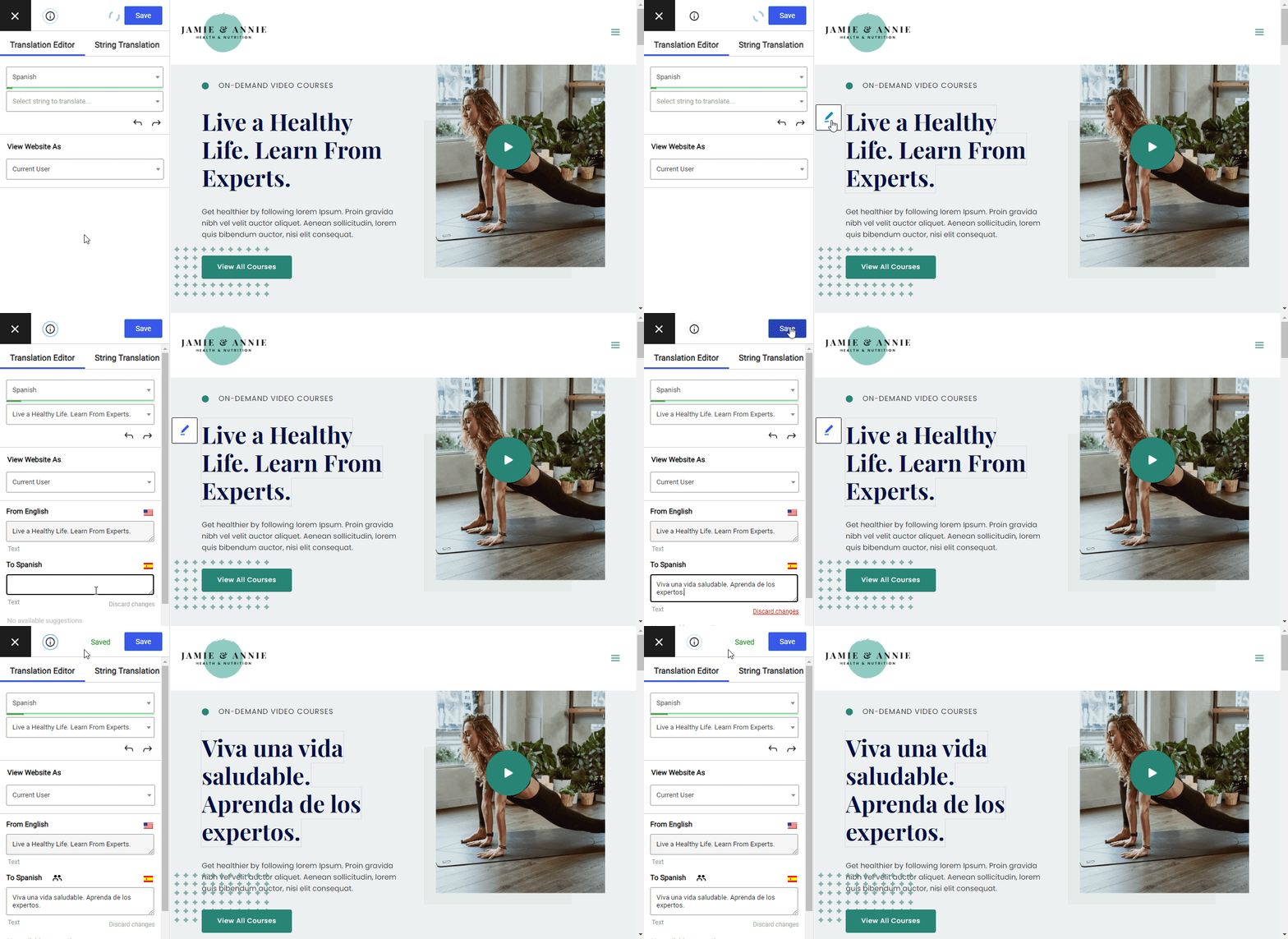
Le plugin propose également plusieurs options très pratiques, comme le montre cette Page de présentation de TranslatePress.
Qu'est-ce qui est encore mieux ? Vous en avez un complètement version gratuite qui vous permet de traduire votre site web comme un chef.
Pour plus de puissance, n'hésitez pas à opter pour le version payante.
TranslatePress Multilingue
Avantages de la traduction : Derniers mots
Dans cet article, nous avons abordé en détail sept avantages de la traduction.
J'espère que vous pouvez maintenant décider si la traduction de votre site web en vaut la peine, en temps ou en argent.
En résumé, les avantages de la traduction incluent une portée accrue, une meilleure image de marque, un meilleur référencement et une augmentation des revenus, entre autres.
Êtes-vous au fait d'autres avantages de la traduction ? Quel a été votre principal enseignement aujourd'hui ? Avons-nous manqué quelque chose ?
Veuillez partager vos réflexions et suggestions dans la section des commentaires ci-dessous.
Bonne traduction, l'ami !