
In this post
Quick Answer: Legal language translation preserves the exact legal meaning of documents like privacy policies and terms of service across languages. For WordPress site owners, the right approach is hiring a qualified legal translator for accuracy, maintaining a terminology glossary for consistency, and using TranslatePress to manage delivery across your site.
If you run a WordPress site serving users in multiple countries, you almost certainly need translated legal documents — and the margin for error is a lot smaller than with the rest of your content.
Three documents matter most here: your privacy policy, your terms of service, and your compliance documents. Each one carries legal weight, and when you translate them for international markets, every word has to hold up. A mistranslation in a marketing headline costs you a click. A mistranslation in a privacy policy can cost you a €50,000 fine.
That gap in consequences is exactly why legal language translation is a discipline in its own right — and why understanding it properly is worth your time before you go live in a new market.
What is Legal Language Translation?
Legal language translation converts legal documents from one language to another while maintaining the exact legal meaning and enforceability. This is more than word-for-word translation because legal concepts don’t always have direct equivalents across different legal systems.
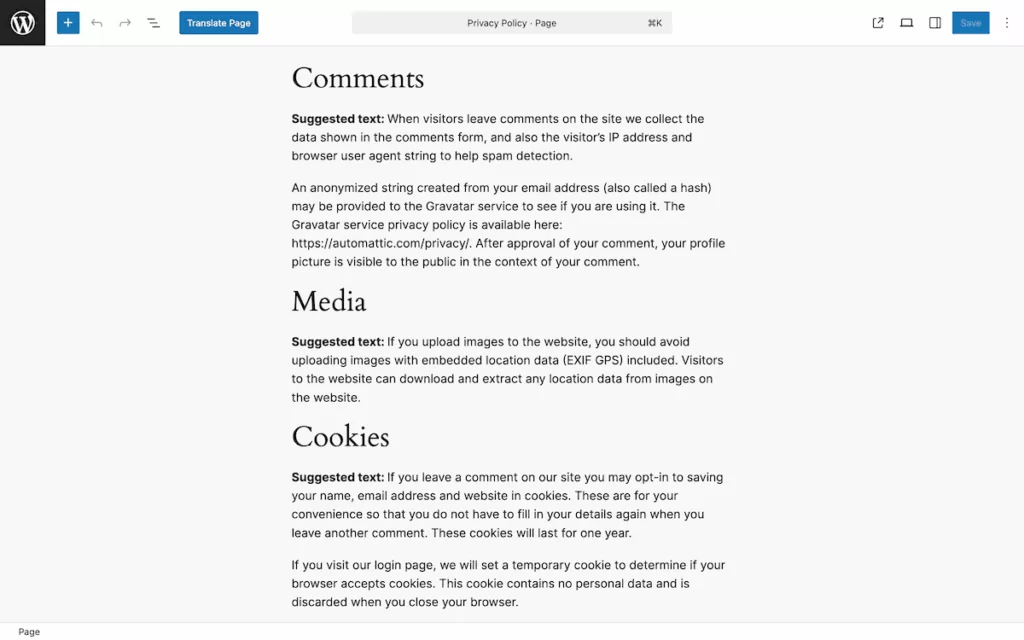
For instance, consider translating a GDPR-compliant privacy policy that mentions “data controller” and “data processor” from English into languages such as Japanese or Arabic. These specific EU legal definitions might not have exact equivalents in legal systems that don’t follow the GDPR.
As such, a translator might need to use descriptive phrases or add explanatory text to convey the same legal meaning. In turn, this will affect how users understand their rights and your obligations.
When you translate a standard marketing email, small variations in meaning won’t usually cause problems. However, when you translate a contract clause, data processing agreement, or privacy policy, precision is critical.
Legal translation covers several document types that your business might need. For instance:
- Contracts and agreements create binding obligations between parties.
- Privacy policies and terms of service inform users about their rights and your practices.
- Compliance documents demonstrate adherence to regulations like GDPR or CCPA.
- Data processing agreements govern how third parties handle customer information.
These aren’t just boxes to tick — each one carries real consequences if the translation fails. Given this, a translator needs to understand both languages at a native level and comprehend the legal systems of both the source and target countries.
What Types of Legal Translation Are There?
Legal translation splits into several categories based on the purpose of the document and the accuracy you need:
- General or standard legal translation provides accurate conversion of legal text between languages. A qualified translator with legal expertise handles the work and ensures the translated document maintains the original meaning.
- Certified legal translation includes a statement from the translator or translation agency that confirms the translation’s accuracy. The certification typically comes with a signed statement, translator credentials, and sometimes a seal or stamp. Courts, government agencies, and regulatory bodies often require certified translations for official submissions.
- Sworn translation involves translators who have taken an oath before a court or government authority. These translators are legally authorized to produce official translations in their jurisdiction.
For your website’s legal documents, standard legal translation by qualified professionals is usually sufficient. Your privacy policy, terms of service, and cookie notices need precision but typically don’t require sworn translation unless specific regulations in your target market demand it.
Why You Need Accurate Legal Language Translation
The stakes are high when it comes to legal translation accuracy so regulatory compliance will form the foundation of your needs. For instance, privacy regulations such as the GDPR require that you present information to users in clear, understandable language or risk heavy fines.
When you serve users who speak different languages, this requirement creates a practical obligation to translate your privacy documents accurately.
What’s more, contract enforceability depends on both parties understanding the terms. When translation errors create ambiguity about obligations, responsibilities, or conditions, the burden is on you and your business.
Ultimately, user trust suffers through poor legal translation. When your main website shows polished, professional translation but your terms of service read awkwardly or contain obvious errors, users are going to question your professionalism.
Of course, spending $500 to properly translate a privacy policy makes a lot of sense when the alternative might be a €50,000 regulatory fine.
The Risks of Poor Translation and Real-World Examples
Depending on how you look at it, it’s fortunate that we have plenty of real-life examples of where translation errors have caused problems. These types of situations show what the real impact could be on your business.
For example, Apple and Samsung have faced off in a number of patent lawsuits over the years. One of the major setbacks Samsung has faced in this litigation is the difficulty of translation between Korean to English (and back again). Experts have cited how hard Samsung’s patent claims were to parse in English. This might not seem to matter, but for a jury, it’s going to create a roadblock to success.
The Daimler-Benz and Chrysler merger in 1998 stands as one of the most complex and expensive failures in translation. In reality, there was far more of a cultural issue at play, but it was exacerbated by mistranslation and misunderstandings between the American and German boards over key terms within the merger agreement:
- Two German governance terms (“Vorstand” and “Aufsichtsrat” were rendered into English as “Board of Management” and “Supervisory Board”). However, a Supervisory Board holds enormous power over the executive board, which the US wing didn’t grasp.
- In German business culture, a “Protokoll” (or minutes of a meeting) carry near-contractual weight. Of course, in the US, informal notes are not binding. While it’s more of a conceptual mistranslation, the impact was that the US didn’t understand the weight of certain points of discussion within those meeting minutes.
The lesson? ‘Supervisory Board’ and ‘Board of Management’ might sound equivalent in English, but one of them had the power to fire the CEO.
Both of these situations show different areas where a mistranslation can cost you dearly. The takeaway is that technical language translation matters just as much as nuance and context. Maybe if each company made the right choice of translator (complete with the correct expertise), the outcomes in both cases would have been different.
Who Can Translate Legal Documents?
Not every qualified translator can handle legal translation properly. Professional legal translators typically hold at least one of three qualification types according to ISO 17100 (the international standard for translation services):
- They might have a degree in translation, linguistics, or language studies from a recognized institution.
- Alternatively, they might hold a degree in another field plus two years of full-time professional translation experience.
- Finally, they might demonstrate five years of full-time professional translation experience without a related degree.
In practice, the third option — five years of experience, no degree — is where you’ll find some of the best specialist legal translators working today. Experience in the actual field beats a linguistics degree every time.
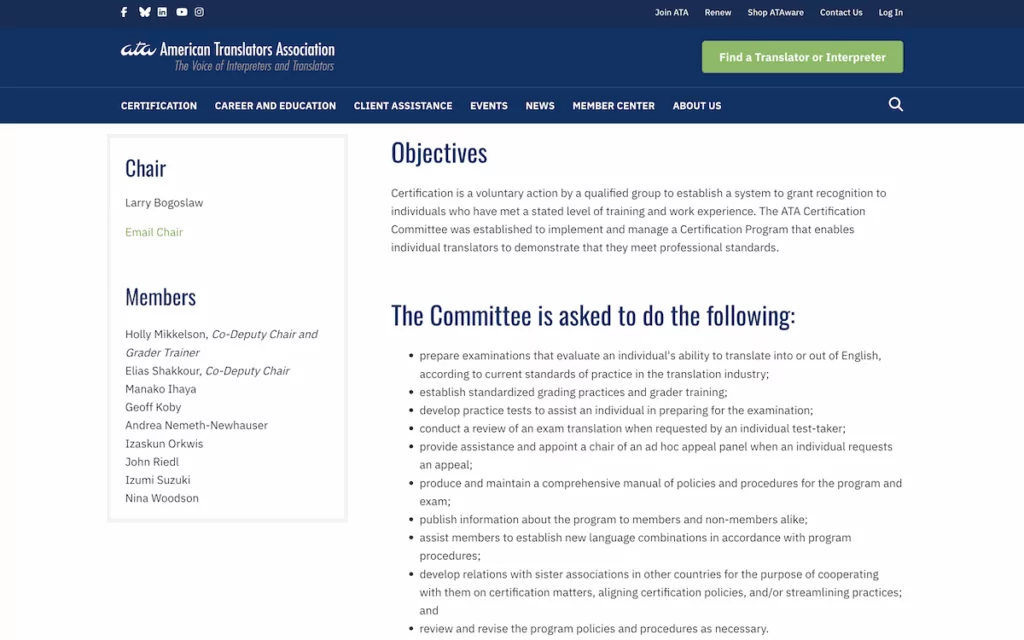
In the United States, the American Translators Association (ATA) certification represents one of the most respected credentials for translators. ATA-certified translators have passed a rigorous examination process and demonstrate professional competence in their language pairs.
It’s the expertise that separates general and legal translators. As such, the translator needs to understand legal concepts, terminology, and systems in both the source and target languages. A translator who speaks perfect French and English might still struggle with legal translation if they don’t understand the differences between common law and civil law systems.
Native language proficiency in the target language is (of course) essential. Legal documents need to read naturally while maintaining precision. A translator who learned a language as an adult, even if fluent, might miss subtle connotations or produce text that sounds awkward to native speakers.
A French-English translator who grew up in France and studied law there might still struggle with a US contract — because French law is civil law and US law is common law, and the two systems don’t just use different words, they think about obligations differently.
Essentially, certified translators give you systematic quality controls beyond just individual translator qualifications, but it’s not the only factor you have to work with.
How Should You Translate Legal Documents? Best Practices
You might be surprised to learn that translating legal documents properly might only require following some established practices. These prioritize accuracy over speed or cost savings, so will often be skipped past by businesses keen to go live.
Of course, it’s important to give your translator the complete context of your document’s wording. For instance, this could be the document’s purpose, the intended audience, any relevant regulations, and whether the translation requires certification. A privacy policy intended for submission to a data protection authority will need different handling than one that only appears on your website.
There are a few other optimal practices to take on board as well:
- Create and maintain a terminology glossary. This should include how specific terms are translated, the context where each term appears, and any terms that should never be translated. Your company name, product names, and certain technical terms might need to remain in the original language. Using a dedicated translation management system will keep things consistent here.
- Implement a two-stage review process. This is in fact mandatory for certified translation services. In any case, the reviewer should be independent from the original translator and should check for accuracy, consistency, completeness, and compliance with target country legal requirements. Think of it like proofreading — you can’t effectively proofread your own writing, and the same logic applies here.
- Compare the translated document against the original, line by line. Legal documents need complete translation without editorial changes unless you explicitly authorize adaptation. Missing a single paragraph in a privacy policy could create a compliance gap.
Finally, while the typical advice is to avoid machine translation for legal documents, it’s not totally without merit. The important aspect is to provide the nuanced understanding that the current tech might not be able to reliably provide. Even so, AI translation is advancing quickly, and it could have a much bigger role in legal translation in the near future.
Leverage TranslatePress for Your Legal Language Translation
This is where TranslatePress earns its place in the workflow — not as a translator, but as the system that keeps everything consistent and accessible once the hard work is done.
TranslatePress can give you the tools to manage multilingual legal content without a hitch. The plugin handles the technical implementation while you maintain control over translation quality by working with qualified legal translators.
TranslatePress Multilingual
Its translation memory will ensure consistency across your legal documents. So, when you translate the term “personal data” in your privacy policy, TranslatePress remembers this translation and suggests it when the same term appears in your cookie policy or terms of service.
This consistency is crucial for legal compliance as directives and regulations will require clear communication about your data practices. Using different translations for the same legal concept across different pages is going to create confusion and potential compliance problems.
Even simple solutions for assigning work can be a boon. TranslatePress lets you create dedicated Translator accounts that restrict full WordPress admin privileges without limiting access to the core translation functionality.
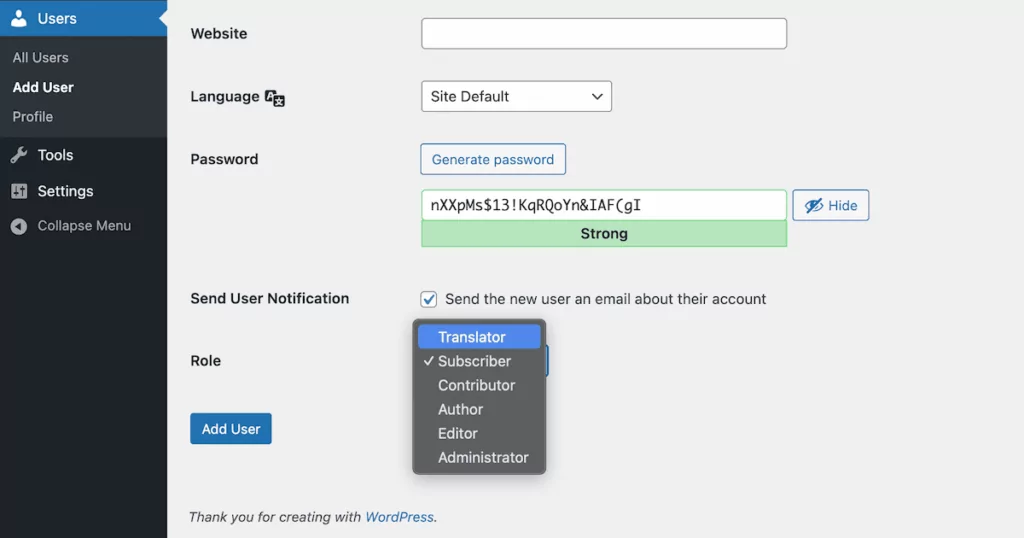
As such, your legal translator can log in, access the translation editor, then submit translations without accessing other site settings. It’s secure while also letting you collaborate with professional translation services.
There are also add-ons to help your legal language translation find the right users, such as the Automatic User Language Detection add-on. For example, the GDPR emphasizes that privacy information must be accessible and understandable. When a French-speaking user visits your site, TranslatePress can automatically direct them to your French privacy policy rather than forcing them to navigate through English content.
However, remember that TranslatePress is not a legal translation service. My advice is to use the plugin’s infrastructure for your legal translation management and work with qualified experts to create the translations. That way, TranslatePress is the facilitator to your efforts while you remain responsible for ensuring your translations are accurate and compliant.
FAQ
Do I need a certified translator for my privacy policy?
Not necessarily. For most websites, a standard legal translation by a qualified professional is sufficient. Certified translation is typically only required when submitting documents to courts, government agencies, or regulatory bodies. That said, if you’re operating in a jurisdiction with specific requirements — such as submitting a GDPR compliance document to a data protection authority — always check local requirements first.
Can I use AI or machine translation for legal documents?
I wouldn’t recommend them as a standalone solution, at least not yet. Current AI translation tools handle general language well, but legal documents require precision with terminology, jurisdiction-specific concepts, and enforceability — areas where AI can still makes costly mistakes. The safer approach is to use AI as a first draft or support tool, with a qualified legal translator reviewing and correcting the output.
What’s the difference between certified and sworn translation?
Certified translation includes a signed statement from the translator confirming the accuracy of the translation. Sworn translation goes a step further — the translator has taken a formal oath before a court or government authority, making them legally authorized to produce official translations in their jurisdiction. Sworn translation is more common in continental European countries, while certification is the standard in the US and UK.
What happens if my translated privacy policy contains errors?
The consequences depend on the nature of the error and your jurisdiction. At minimum, users may misunderstand their rights or your obligations. More seriously, inaccurate legal translations can expose you to regulatory fines — GDPR penalties alone can reach €20 million or 4% of global annual turnover — as well as contract disputes or reputational damage. The cost of getting it right upfront is almost always lower than the cost of fixing it after the fact.
Does TranslatePress translate legal documents automatically?
TranslatePress can apply automatic translation to any content on your site, including legal pages, using TranslatePress AI — no API keys or complicated setup needed. However, for legal documents specifically, I recommend using automatic translation as a starting point and having a qualified legal translator review and refine the output before publishing. TranslatePress makes it easy to assign that review work to a dedicated Translator account.
TranslatePress Helps You Manage Legal Translation Implementation
Proper legal translation protects your business from regulatory penalties, contractual disputes, and reputational damage. Given this, the cost of professional legal translation represents a small investment compared to the potential consequences of translation errors.
For most WordPress site owners, the right setup is a qualified legal translator for accuracy, a terminology glossary for consistency, and TranslatePress to handle delivery — that combination covers compliance, UX, and peace of mind.
TranslatePress provides you with the tools to implement and manage legal translations created by qualified professionals. The plugin handles the technical aspects of displaying multilingual legal content while you maintain control over translation quality. Even so, you’ll want to work with translators who understand both the legal concepts in your documents and the regulatory requirements in your target markets.
TranslatePress Multilingual
Have you had to manage legal translations for your WordPress site? Let me know how you handled it in the comments.