
In this post
Some English-speaking markets represent four of the highest-value e-commerce opportunities available. The United States alone generated $1.2 trillion, according to the US Census Bureau. The UK, Canada, and Australia all offer the same promise, so if your business already publishes in English, there’s no language barrier preventing you from reaching any of them.
However, expanding into English-speaking markets without accounting for the inherent differences in each country will limit your organic visibility and reduce your conversion rate. I’m going to show you how to identify which markets are worth entering, what content to adapt for each, and how to manage the technical SEO for these regional English variants.
Quick Answer: To expand into English-speaking markets, research how search terms differ in each market, create separate regional pages only when pricing, products, promotions, or copy genuinely differ, and use country-specific hreflang tags (en-US, en-GB, en-CA, en-AU) so Google serves the right version. TranslatePress manages the regional variants and hreflang tags automatically.
Why English-speaking markets deserve a dedicated strategy
The instinct to treat English-speaking expansion as a simpler version of international SEO is understandable, but it misses the point on a few levels.
For instance, US and UK visitors may search for the same product using different terms. They also expect prices in different currencies, and follow different calendar conventions, seasonal patterns, and cultural references.
DeepL’s report from 2024 notes that three-quarters of business leaders think localization boosts customer engagement, even when all markets share a language. You can see those differences in a few categories:
- Vocabulary. The same product can carry a different name in each market, which flows directly into keyword strategy and on-page copy.
- Spelling conventions. British, Australian, and Canadian English use different spellings from American English.
- Cultural and seasonal context. Public holidays, seasonal timing, and local consumer events change between markets and affect your content calendar.
- Pricing and regulatory expectations. Currency display, consumer protection language, and tax conventions vary by country in ways that make generic copy feel out of place.
The four markets I’m discussing have well-developed e-commerce infrastructure, high consumer confidence in online purchasing, and mature digital advertising ecosystems. It’s a superb opportunity: one that uses a multilingual SEO strategy as the foundation.
The four main English-speaking markets and what makes each one viable
To help summarize the four markets I’m talking about, here’s a quick table of the major differences.
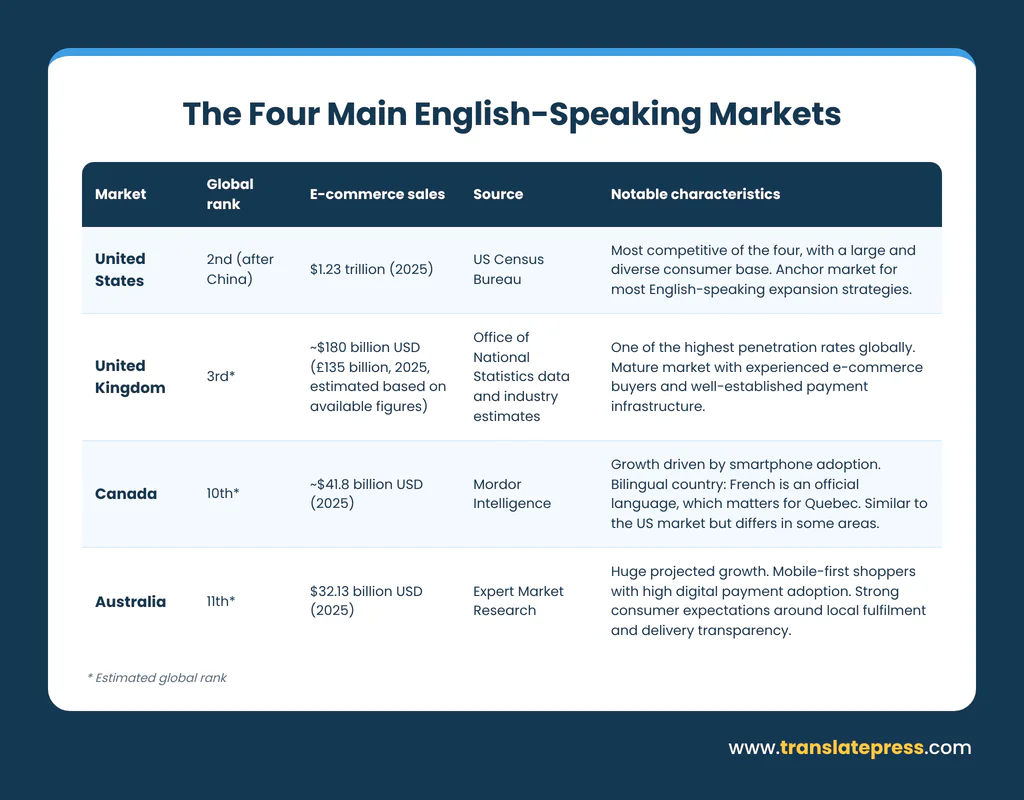
Sources: US Census Bureau, Office of National Statistics, Mordor Intelligence, Expert Market Research.
Of course, these statistics are constantly changing, so you’ll also want to do your own research on the current makeup of these markets.
How to research regional search behavior across English-speaking markets
You might already know that the UK says “trainers” where the US says “sneakers”, but the differences run deeper than vocabulary. It’s all about intent, which questions they ask, and even which modifiers customers attach to product searches. The only reliable way to understand this is through research.
First off, start with keyword tools filtered by a single target country. Run these seed keywords through your tool of choice once per market and compare the volume data side-by-side. You’ll often find that a term performing strongly in one market returns negligible volume elsewhere because those markets use different phrases.
It’s also a good idea to export the full keyword set for a given seed term, including related terms, questions, and search suggestions. Running this process and comparing the outputs will surface vocabulary gaps and other intent differences that you can take further.
Next, Google Trends is a great way to compare search interest for two terms across different countries. Here, you can set both terms as inputs and compare their relative search interest by region, which is useful for understanding ‘traction’ for specific terms in a market.
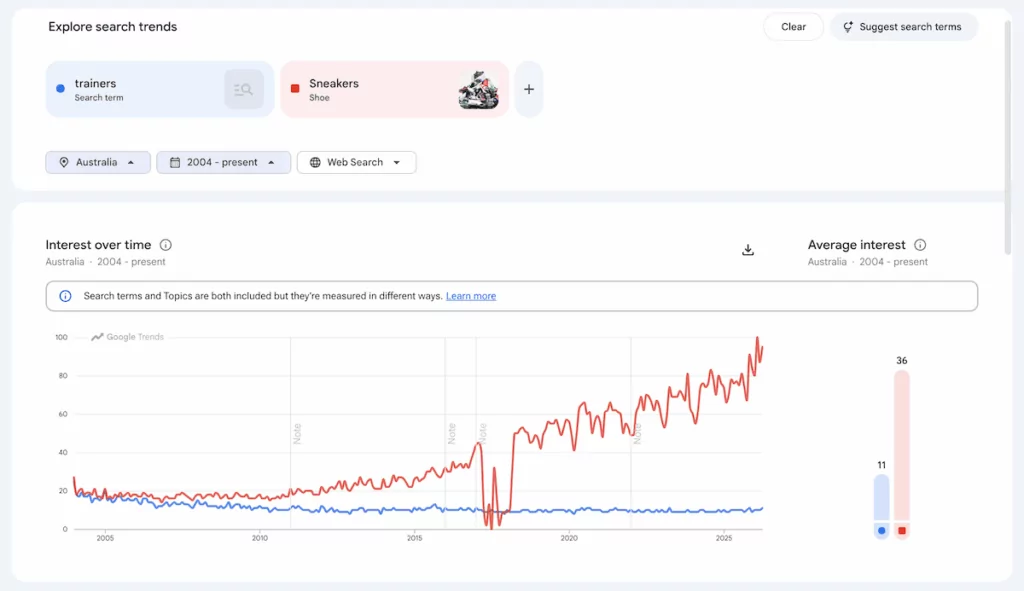
Finally, it’s a good idea to carry out some ‘manual’ research too. For instance, you could search for your core product or category terms directly in Google, with your location or VPN set to each target country. The pages that rank organically in that market will already be optimized, so look at the title tags, H1 headers, and product copy of the top three to five results in each country.
You could also have a native speaker from the target country review your proposed terms and copy to catch local slang, regional idioms, or culturally specific usage patterns. Regardless, all of this feeds into your decision about whether to create separate pages for each region or share content across markets.
When to create separate pages and when to share content
The ‘fork in the road’ will come down to either maintaining separate regional pages or using shared content with hreflang annotations. To make this decision, ask yourself one question:
Does this market receive content that is genuinely different from another?
It’s essentially the same distinction that separates translation from localization, which matters more at the page level than you’d expect.
For a page that displays the same product, price, and copy as the target language, a shared page with a language-only en hreflang tag is a solid starting point. However, separate pages will be warranted once any of the following apply:
- Pricing differs between markets. The content and user intent between a UK page showing pound pricing and “free delivery over £50” is different to a US page showing dollars and “free shipping over $60”.
- Product availability or range varies. If you sell different SKUs in different countries, each market needs its own pages.
- Promotions are market-specific. A Black Friday campaign targeted at UK shoppers should not rank for US queries, and vice versa.
- Copy has been locally adapted. If you have rewritten product descriptions to use regional vocabulary or address local consumer concerns, that content is distinct enough to deserve its own URL.
My recommendation is to start with your highest-traffic product and category pages and audit the differences between markets. Once you have separate pages in place, your hreflang setup needs to reflect each individual regional variant rather than a single language-only tag.
How hreflang works for regional English variants
Hreflang tags tell search engines which version of a page to serve to users in a given language and region. For English-speaking markets, the four tags you need are:
en-USfor the United Statesen-GBfor the United Kingdomen-CAfor Canadaen-AUfor Australia
These combine ISO 639-1 language codes with ISO 3166-1 Alpha-2 country codes. The language code is lowercase; the country code is uppercase.
Also, Google distinguishes between multilingual and multi-regional sites. So, an en-US and en-GB setup is multi-regional given it uses the same language for different countries. Tags still need to be in place for Google to serve the right regional version to each market. Without them, Google makes its own decision about which version to show, which may not align with your content strategy.
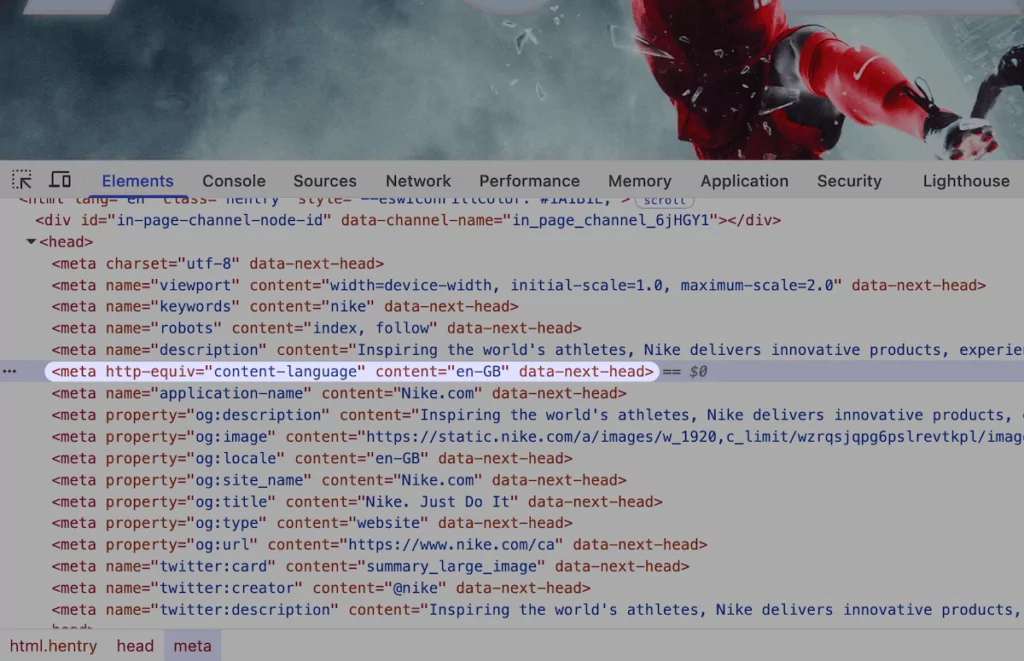
The tags also need to be ‘bidirectional’ as well as needing a self-referencing tag. This means your US page points to your UK page, your UK page points back to your US page, and both point to themselves. Missing these is among the most common hreflang errors.
A common worry is that en-US and en-GB pages will be treated as duplicate content. In practice, regional variants are exactly what hreflang is designed for. If two pages are near-identical, Google may cluster them and choose one to index, which is how the wrong version ends up in front of the wrong market. Hreflang tells Google they’re intentional alternates, so it can serve the UK page to UK searchers and the US page to US searchers. It also helps to make each version genuinely different, with local pricing, vocabulary, and delivery details, and to keep each page’s canonical tag pointing to itself rather than to the other region’s page.
How TranslatePress handles regional English variants
Managing hreflang manually across an entire site can increase your work as your content grows. In short, TranslatePress automates the technical layer, so you can focus on adapting content rather than maintaining markup.
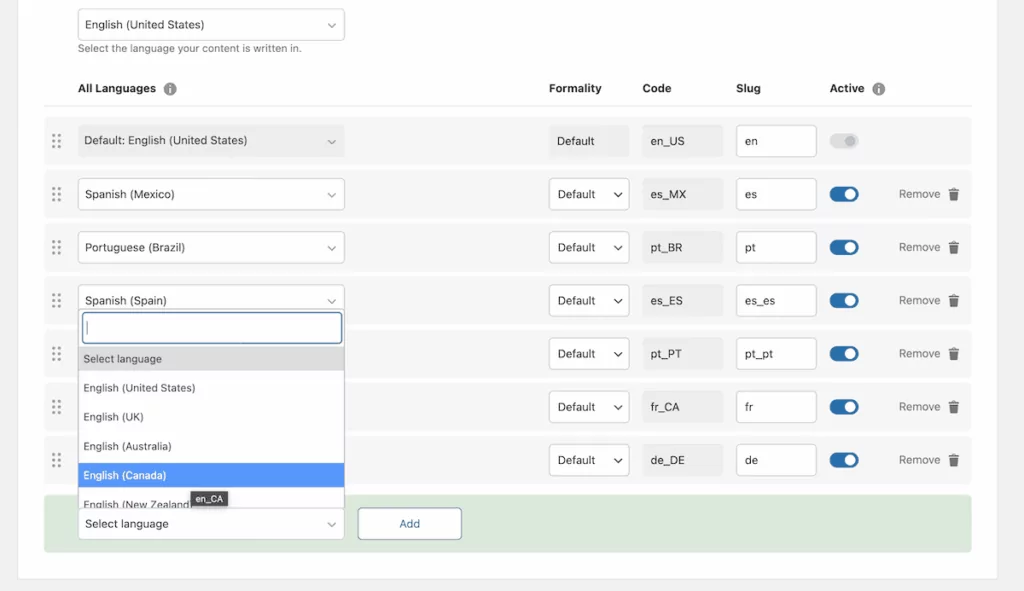
If you head to Settings → TranslatePress → General within WordPress, you can use the drop-down menu under All Languages to add each regional English variant:
- English (United States)
- English (United Kingdom)
- English (Australia)
- English (Canada)
TranslatePress treats each entry as an independent language with its own translation set and each variant is managed separately.
TranslatePress Multilingual
Once your regional variants are active, TranslatePress generates hreflang tags for every page type on your site. It uses correct ISO language and country codes, produces absolute URLs, and updates the tag network when you add new content or change a URL slug.
The plugin also works alongside your choice of WordPress SEO plugin (such as Yoast SEO, Rank Math, and AIOSEO) to keep your multilingual XML sitemap current across all regional variants.
Adapting content between English regional variants
Once you set up languages, the content work happens inside the visual Translation Editor. You access it through the Translate Site link in the WordPress toolbar, then select any string on the page. The left-hand sidebar shows a separate input field for each active language variant.
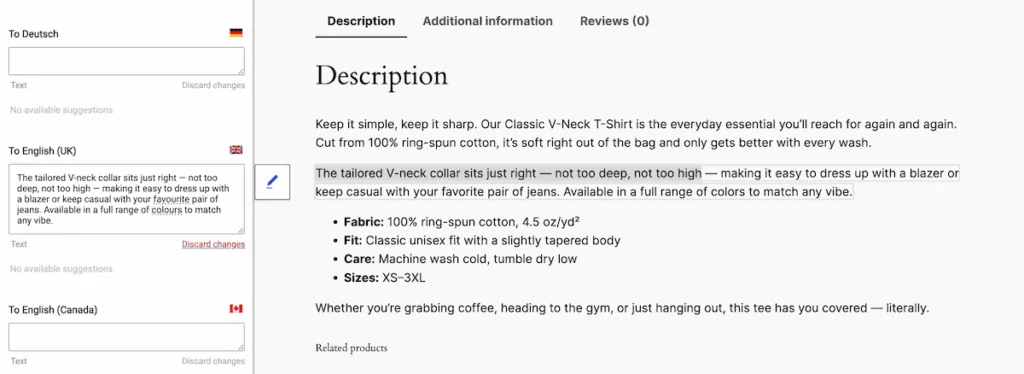
It’s here you adapt keyword-sensitive copy, pricing references, delivery messaging, and any other content that differs between markets. What’s more, because you’re working with the live front end, you can spot and repair layout problems from text length differences before you go live.
Finally, the Automatic User Language Detection functionality routes first-time visitors to the correct regional version based on browser settings or IP address. There are different detection permutations to choose from and you can even include pop-ups to help notify users of a language change on screen.
Frequently asked questions about expanding to English-speaking markets
What Are the Biggest English-Speaking Markets for E-Commerce?
The United States is by far the largest, with roughly $1.23 trillion in e-commerce sales in 2025 and a global rank of second behind China. The United Kingdom comes next at around £135 billion, followed by Canada (about $41.8 billion USD) and Australia (about $32.13 billion USD). Each has mature online shopping habits, but they differ in vocabulary, pricing, and consumer expectations, so it’s worth adapting your content for each one rather than treating them as a single English market.
Do I need separate pages for each English-speaking market?
If the product, price, and copy are the same, a single English page is sufficient. However, when pricing, promotions, product availability, or regionalized copy differs between markets, separate pages with individual hreflang tags will perform better in local search.
What hreflang tags do I need for English-speaking markets?
The codes are en-US for the United States, en-GB for the United Kingdom, en-CA for Canada, and en-AU for Australia. Each tag needs to be bidirectional, which means every regional page must reference all other regional versions, plus itself. Using en without a country code targets English speakers globally but does not differentiate between markets.
Will Google treat my en-US and en-GB Pages as duplicate content?
Not if you set them up correctly. Regional English pages with similar content are a case hreflang is built to handle. Add bidirectional hreflang tags with country codes, give each page a self-referencing canonical, and localize pricing, spelling, and product details so every version has a clear purpose. That way Google serves the right page to each market instead of picking one for everyone.
How do I research keyword differences between English markets?
Google Keyword Planner with location targeting set to each individual country is ideal. Tools such as Ahrefs and Semrush also let you filter keyword data by country, so you can see search volume and competition for specific terms in each market.
Does TranslatePress support en-GB, en-AU, and en-CA hreflang tags?
Yes. When you add English regional variants in the TranslatePress language settings, you also get the appropriate hreflang tags (including country codes) automatically across your entire site.
Build your English-speaking market strategy one region at a time
The English-speaking markets are a lucrative e-commerce opportunity. While the barrier to entry is lower than entering a foreign-language market, the translation and localization work still needs to be done properly. TranslatePress runs in the background to keep your translations up to date and highly accurate.
TranslatePress Multilingual
Starting with qualified markets from your analytics data is the most efficient approach. With the performance data from your first regional variant, you can expand to the next market with more confidence about what adapts and what performs.
Do you have questions about setting up variants for English-speaking markets? Share them with me in the comments section below!