
In this post
Let me be as clear as possible from the off: Yes, search engines will index your AI-translated pages! However, whether those pages turn into SEO visibility in the form of rankings and appearing in AI-driven results is a separate question. The answer comes down to quality and implementation rather than translation method.
If you’re running a multilingual WordPress site and wondering whether AI translation will tank your search rankings, this one’s for you.
There has been a lot of noise with search engines around AI content, what counts as spam, and whether machine translation carries a risk. I’m going to explain what SEO visibility is, but also talk about how machine-translated content is treated, what the research says about translation and AI search, and what you need to do to make sure your translated pages perform.
What SEO Visibility Is and Why It Matters
Quick Answer: Yes — search engines index AI-translated pages, and Google doesn’t treat machine translation as spam. Your SEO visibility depends on content quality and technical setup (metadata, hreflang tags, sitemaps), not translation method.
SEO visibility is a metric that measures whether your site shows up across a set of tracked keywords in search results. Think of it as your share of search real estate: the more keywords you rank for (and the higher those rankings sit), the more visible you are.
Each tool will calculate it differently, but the underlying logic is consistent. Your rankings are weighted by the Click-Through Rate (CTR) each position tends to receive, then multiplied by the search volume for that keyword. Semrush expresses this as Visibility %, calculated in its Position Tracking tool; Ahrefs offers its Brand Radar that works on the same principle; other tools use an absolute index weighted by position and search volume.
What a Good SEO Visibility Score Looks Like
However, there’s no universal benchmark score, so 40 percent will mean something different depending on how competitive your keyword set is. Instead, your best reference points are your own historical trends and your competitors’ scores for the same keywords.
What moves the score most is where you rank, not simply how many keywords you track. Backlinko’s stats say that the top organic result captures around 27 percent of all clicks, while a result on page two receives fewer than 1 percent. A single position improvement in the top three rankings can shift your visibility score more than dozens of lower-ranking improvements combined.
Also, each language your site operates in represents its own keyword set, SERPs, and visibility score to build. So, a 35 percent visibility score in English says nothing about your visibility in French, German, or Spanish.
This is exactly where machine translation becomes strategic because translating your site into five languages also creates five separate ceilings for search visibility that you can now start building towards.
Google’s Policy Shift on Machine Translation
For years, Google’s official documentation recommended that site owners use robots.txt to block auto-translated pages as they could be viewed as spam. However, a June 2025 Google Search Central update switched things up:
“…removed a section from our multilingual documentation about using robots.txt to block all automatically translated pages. Why: To align with our spam policy update in March 2024. This is a docs-only change, no change in behavior…”
That final phrase is worth sitting with. In short, nothing in Google’s algorithms has changed, but the documentation now reflects what the spam policies say: the problem is not machine translation itself, but low-quality content produced at scale.
What Google’s spam policy says about translated content
Google’s Scaled Content Abuse policy lists “automated transformations like…translations” as a potential violation, but only where it produces content that provides “little to no value to users”. This means translating poor content at scale (or producing pages that make no sense to a reader) is where the risk sits.
In fact, Google confirmed this directly in a statement to Search Engine Land, responding to questions about Reddit’s large-scale use of AI-translated content:
“…our policies do not strictly define content that has been translated by AI as spam…”
The nuance is that if you translate high-quality, helpful content the translations inherit the same standing as the source. Translate thin or low-effort content and you scale the problem, not the value.
This aligns with Google’s broader position on AI-produced content and its general quality updates: it essentially rewards helpful content regardless of how it is produced. EEAT – Expertise, Experience, Authoritativeness, and Trustworthiness – applies to translated pages in the same way it applies to the originals.
Why Translation Has Become an AI Search Signal
All of this is to say: SEO visibility is no longer about ten blue links. Google AI Overviews now appear in a majority of search results and for more than 40 languages.
However, for queries where an AI Overview is present, organic clicks for uncited pages have fallen by an estimated 61 percent (based on Search Engine Land’s figures). Sites cited within the Overview see a CTR of up to 35 percent higher than the competition on the same query.
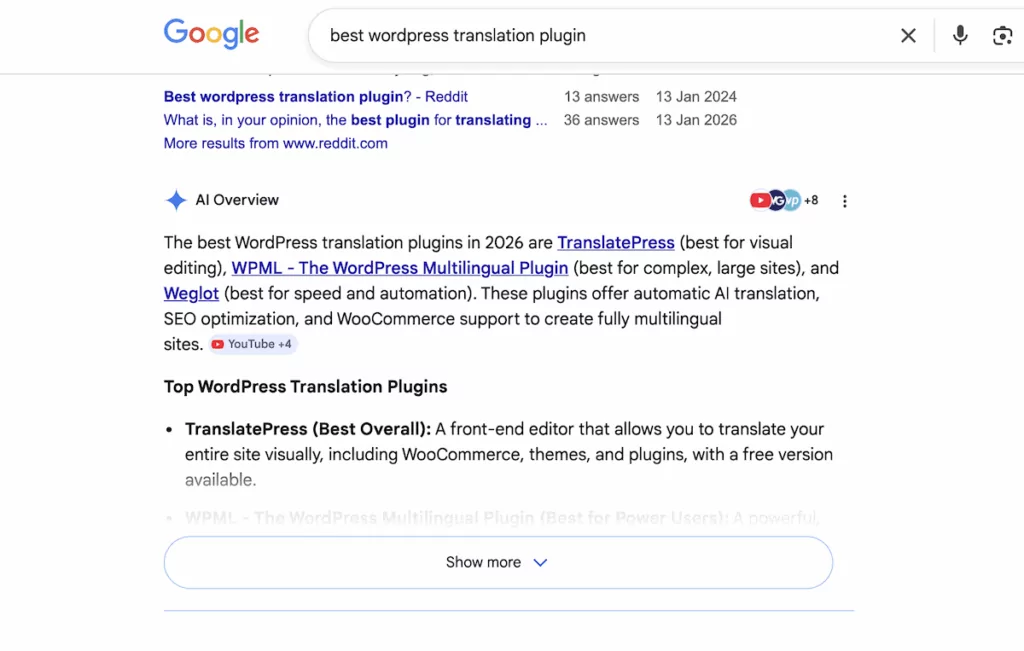
Google’s own documentation on its AI functionality states that there are no additional technical requirements other than typical search optimization to appear in AI Overviews. The eligibility criteria is the same here as it is for organic search: a page must be indexed and eligible to appear with a snippet, while quality and relevance determine selection.
The takeaway here is: if your content is not in the language of the question, it won’t be in the answer.
What Quality Means for a Machine-Translated Page
The quality bar that matters for SEO is not a linguistic purity test. Modern neural machine translation systems (such as DeepL or Gemini-powered Google Translate) and the engines underpinning tools such as TranslatePress AI can produce translations that meet a functional threshold for the vast majority of content.
TranslatePress Multilingual
Instead, what Google’s Helpful Content guidance actually asks is: would someone reading this page feel they learned enough to achieve their goal and are satisfied with the experience?
For translated pages, quality failure tends to show up in some specific, avoidable ways:
- Untranslated metadata signals that the page is incomplete.
- URL slugs that are English words transliterated rather than translated miss the keyword relevance that local searches rely on.
- Pages with high bounce rates and a short dwell time will send the same signals to Google as poor-quality source pages do.
- Content with cultural references that don’t transfer creates experiences that won’t feel local.
A hybrid workflow of using a first layer of machine translation followed by human review for key pages covers these bases. AI can handle the volume and the speed while human reviewers can address cultural mismatches, terminology, and anything that reads as unnatural.
How to Increase SEO Visibility for Your Translated Pages
Assuming your source content is helpful, original, and well-structured, there are a few other steps you can take to understand whether your translated pages can win visibility. First, translate your SEO metadata, not just page content.
This means title tags, meta descriptions, Open Graph data, and all image ‘alt’ text need to be in the target language. In fact, untranslated metadata is one of the most common reasons for poor multilingual performance in local SERPs.
Likewise, translated URL slugs contribute to keyword relevance in the local search results for a target language. So, a URL such as /es/how-to-build-a-website carries less relevance for Spanish searches than /es/como-crear-un-sitio-web.
However, multilingual SEO also has a number of technical requirements that will improve your SEO visibility:
- Implement
hreflangtags correctly. Every language version of a page must reference all other versions, including itself using hreflang tags. Broken tags are a big factor in translated pages either failing to rank or cannibalising each other. - Submit a multilingual XML sitemap. Your sitemap needs to include all language versions to ensure search crawlers discover your translated pages.
- Check for indexing in Google Search Console. You can use the URL Inspection tool to confirm your translated pages are indexed and free of coverage errors. Unindexed yet translated pages contribute nothing to your visibility score in that language.
It’s important to remember that every piece of content on your source site that lacks a translated counterpart is a gap in your multilingual SEO visibility. TranslatePress’ automated detection and content translation helps to keep your language versions current without manual effort.
How TranslatePress Builds SEO Visibility for Your Translated Pages
TranslatePress is built on the premise that translation without implementing SEO is incomplete. The plugin handles the entire technical layer that determines whether your translated pages have SEO visibility in every language you target.
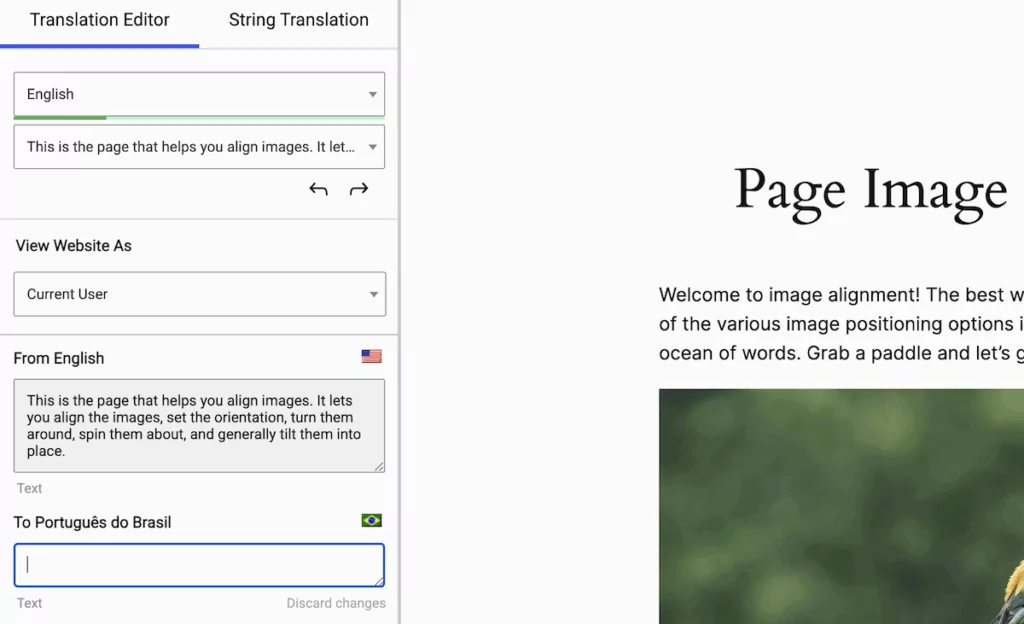
TranslatePress’ SEO Pack add-on translates page titles, meta descriptions, and URL slugs for every page, post, and product in your site. This is in addition to Open Graph titles, descriptions, and Twitter/X Card data.
The plugin also generates hreflang tags automatically across both the HTML head and your sitemap with correct ISO language and country codes. For example, you can configure regional variants (such as es-ES and es-MX) and the plugin builds the full tag network across every page for you.
What’s more, the HTML lang attribute is set correctly on every page, which gives browsers and assistive technologies clear signals about the language of the content.
TranslatePress will also translate WooCommerce product pages, variable product pages, category archives, cart and checkout pages, and the customer account area. This means you can offer the full multilingual SEO coverage an international store needs in order to rank well.
Frequently Asked Questions (FAQs)
Will Machine-Translated Pages Be Penalized by Google?
Not if the underlying content is helpful and the translation reads coherently. Google doesn’t automatically consider machine-translated content to be spam. Instead, the quality of the source material matters as much as the quality of the translation.
Does Translating My Site Improve My SEO Visibility Score?
Yes, directly! Each translated version of your site creates new pages that can rank in a language’s search results. In turn, this expands your keyword footprint and builds a new visibility score in each market you enter.
Do Translated Pages Appear in Google AI Overviews?
They can, given quality optimization. It could be that your translated SEO pages do so at a higher rate than untranslated sites.
What Is a Good SEO Visibility Score?
There is no universal answer here. Visibility scores are relative to your keyword set and the competitiveness of your market. Instead, track your own trends over time and benchmark against direct competitors using the same keywords.
Does My SEO Plugin Need to Support Multilingual Sitemaps for hreflang Tags to Work?
If you’re using TranslatePress, the SEO Pack add-on handles hreflang tag output in both the HTML head and the XML sitemap. It also works with Yoast SEO, Rank Math, AIOSEO, and SEOPress. As such, you don’t need to configure hreflang tags separately.
In a Nutshell, SEO Visibility Is the Whole Point of Translation
If your content doesn’t exist in the language of the question, it doesn’t exist for that searcher — full stop.
Going multilingual has always been about reaching more people. However, the current change is that SEO visibility (particularly in AI-driven search) now depends on whether your content exists in the language of the person asking the question. Machine translation makes that even easier and more achievable than ever.
Google makes this explicit in its own documentation, but the responsibility that comes with it is the same as it has always been for any content. As such, you’ll need to ensure you make your content helpful, implement it correctly, and give search engines the signals they need to understand it. A plugin such as TranslatePress can help with most (if not all) of these aspects.
TranslatePress Multilingual
Has AI translation affected your site’s SEO visibility — for better or worse? I’d love to hear about it in the comments.